SDS database
Searchable database of all safety data sheets. Automatic version control ensures the latest version is always displayed. Upload or link SDS per product.
Spineweb brings together all safety data sheets (SDS), chemical registers and risk assessments in a searchable, web-based database — with links to legal monitoring, routines and case management.
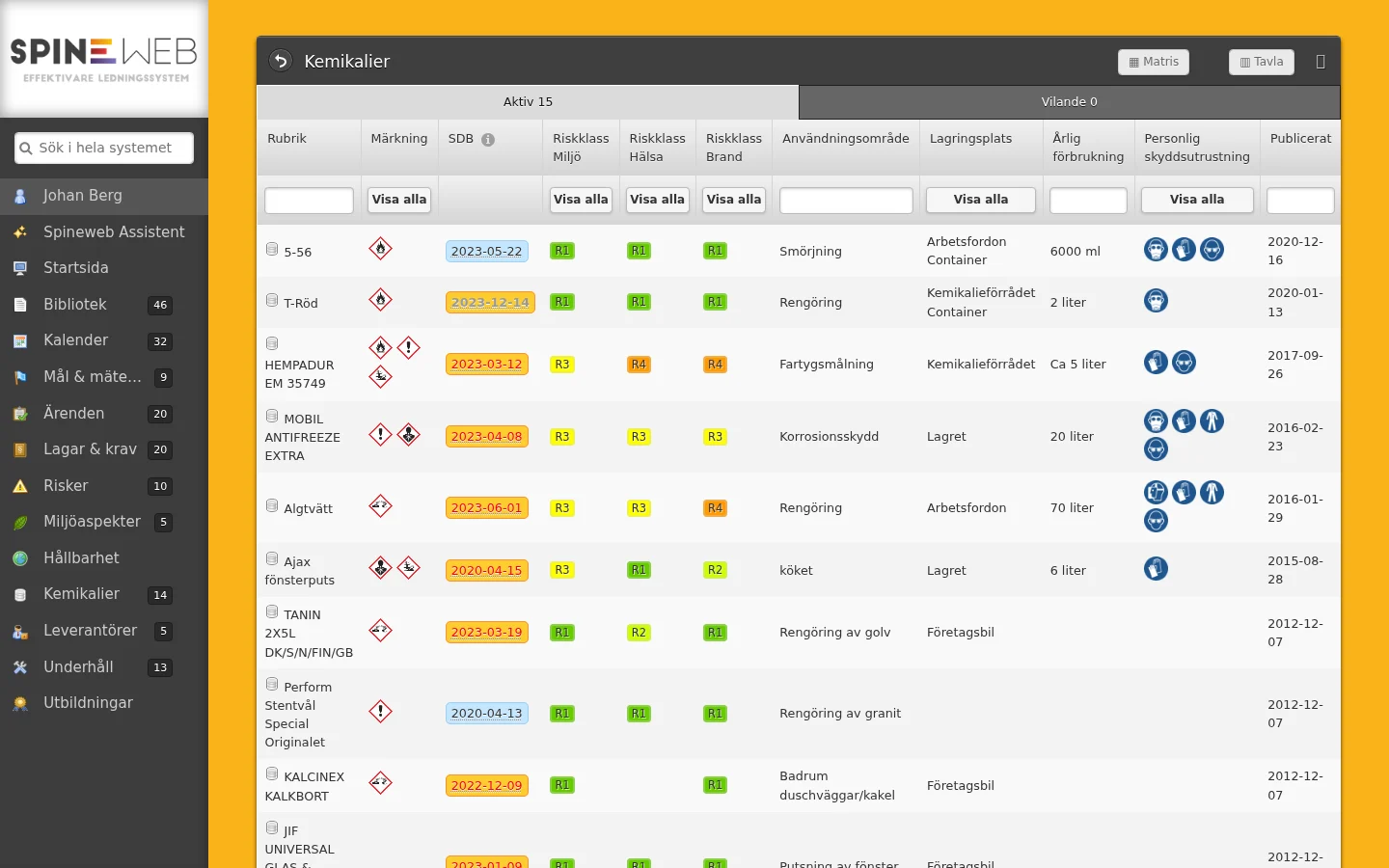
Chemical management in an organization involves systematically identifying, registering, assessing and controlling chemical products used in operations. It is about ensuring the right information about each chemical is available to affected employees — in the form of current safety data sheets (SDS), risk assessments and handling routines.
Without a digital chemical management system, it is common for SDS data sheets to be scattered in binders, on servers and in email — often outdated and difficult to find. The consequences can be serious: employee exposure to hazardous substances, non-compliance with occupational health and safety authority requirements, and loss of certification.
The REACH regulation governs the manufacture, import and use of chemical substances and requires registration, communication via SDS and management of substances of very high concern (SVHC). The CLP regulation governs classification and labelling of chemicals and requires SDS to always be updated with correct classification. Spineweb's chemical management module helps you ensure these requirements are met on an ongoing basis.
One of the biggest challenges in chemical management is that information must be available exactly where the chemicals are used. With Spineweb's QR code feature, employees can scan a code on the packaging and immediately see the current SDS, risk assessment and handling routine — without needing to log in or search the system.
Full control of chemicals, SDS and risk assessments — accessible wherever and whenever needed.
Searchable database of all safety data sheets. Automatic version control ensures the latest version is always displayed. Upload or link SDS per product.
Complete chemical inventory per workplace, department or process. Classification, hazard pictograms and quantity information collected and searchable.
Link chemical risk assessments directly to products in the database. Document exposure, protective measures and residual risks per chemical and work task.
Generate QR codes for each chemical. Employees scan and immediately see the current SDS, risk assessment and handling routine — without login.
Track SVHC substances, verify SDS are updated according to current CLP classification and monitor REACH requirements in the legal monitoring module.
Automatic reminders when an SDS is older than a defined interval or when a supplier publishes a new version. Keep your chemical database current without manual monitoring.
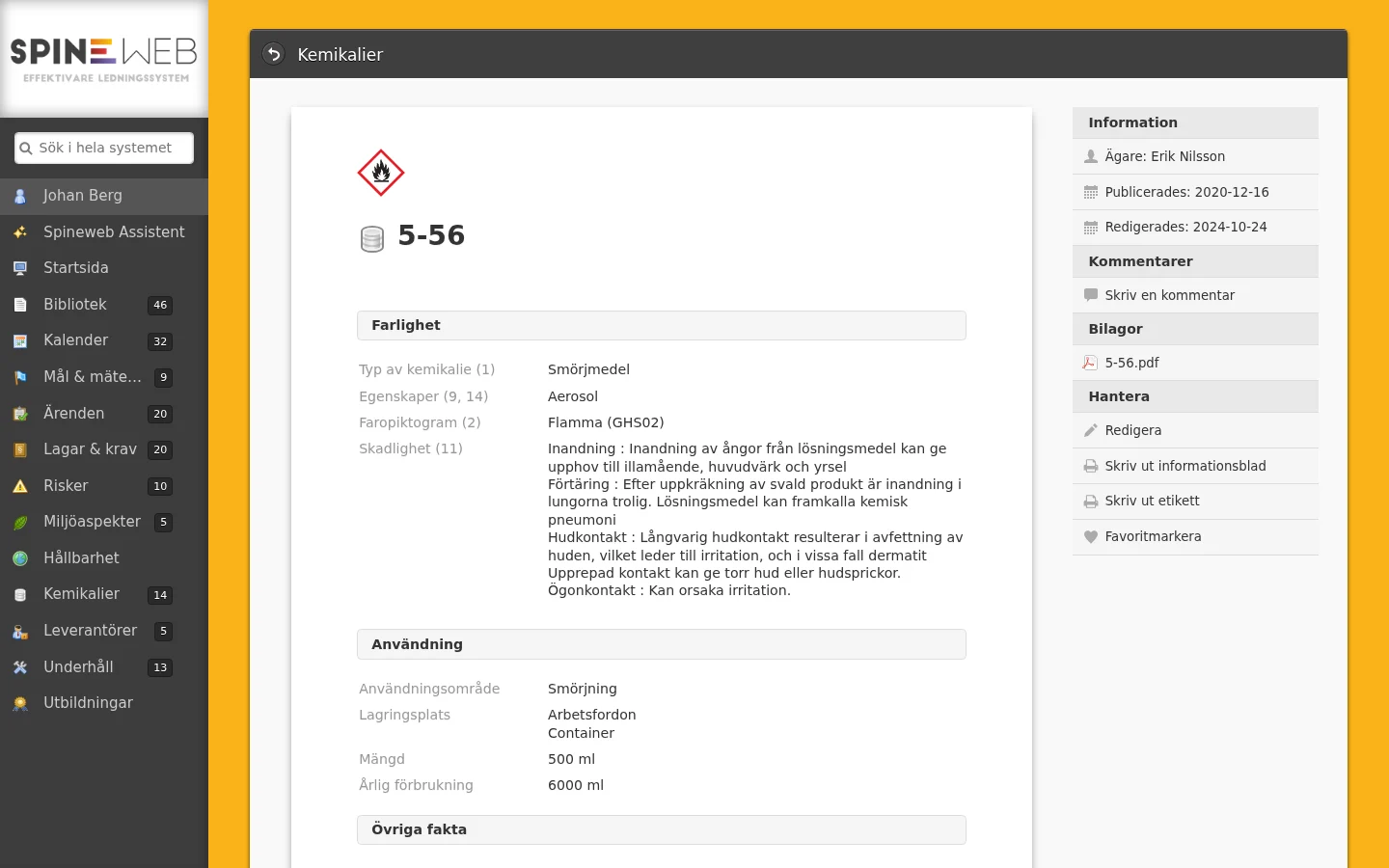
Chemical management in Spineweb is tightly integrated with legal monitoring, case management and document management.
The assistant can search your chemical database and help you find SDS sheets, risk assessments and chemicals needing attention.
AI processing runs on AWS Bedrock in eu-north-1 — your data never leaves the Nordics.
Chemical management in an organization involves identifying, registering, assessing and controlling chemical products. A digital system brings together all safety data sheets (SDS) in a searchable database, links chemicals to risk assessments and routines, and ensures all information is current and accessible to affected employees.
A safety data sheet (SDS) is a standardized document with information about a chemical product's properties, hazards, safe handling and emergency measures. SDS is required for all hazardous chemicals and must be accessible to everyone who handles the product. Without current SDS, the organization risks violating REACH regulation and occupational safety regulations.
REACH regulates the manufacture, import and use of chemical substances. For Swedish companies, REACH requires registering manufactured or imported substances over one tonne per year, requesting and providing SDS, identifying and communicating SVHC substances, and in some cases applying for authorization for regulated substances.
CLP (Classification, Labelling and Packaging) harmonizes the classification and labelling of chemicals in the EU. CLP requires hazardous substances to be labelled with standardized hazard pictograms, signal words and hazard statements. CLP affects how chemicals are communicated in SDS and requires SDS to always be updated with correct classification.
A chemical risk assessment identifies the risks of using a specific chemical at your workplace. The process includes: identify the chemical and its hazards via SDS, assess exposure (who, how, how often, how long), assess the risk with existing protective measures, and determine additional measures. In Spineweb, risk assessments are linked directly to chemicals in the database.
Yes. The Work Environment Act and AFS 2011:19 on chemical work environment risks require employers to have full knowledge of which chemical products are present at the workplace. In practice this means a chemical register with associated SDS for all chemicals. Spineweb's chemical management module meets these requirements and greatly simplifies supervisory matters.
Book a demo and see how Spineweb brings all SDS, risk assessments and chemical routines together in a web-based system.