Legal register
Build a structured register of laws, regulations, directives and authority requirements relevant to your operations, categorized by area.
Spineweb helps you systematically monitor laws, regulations and authority requirements relevant to your operations — with links to responsible parties, evaluation intervals and documented evidence of compliance.
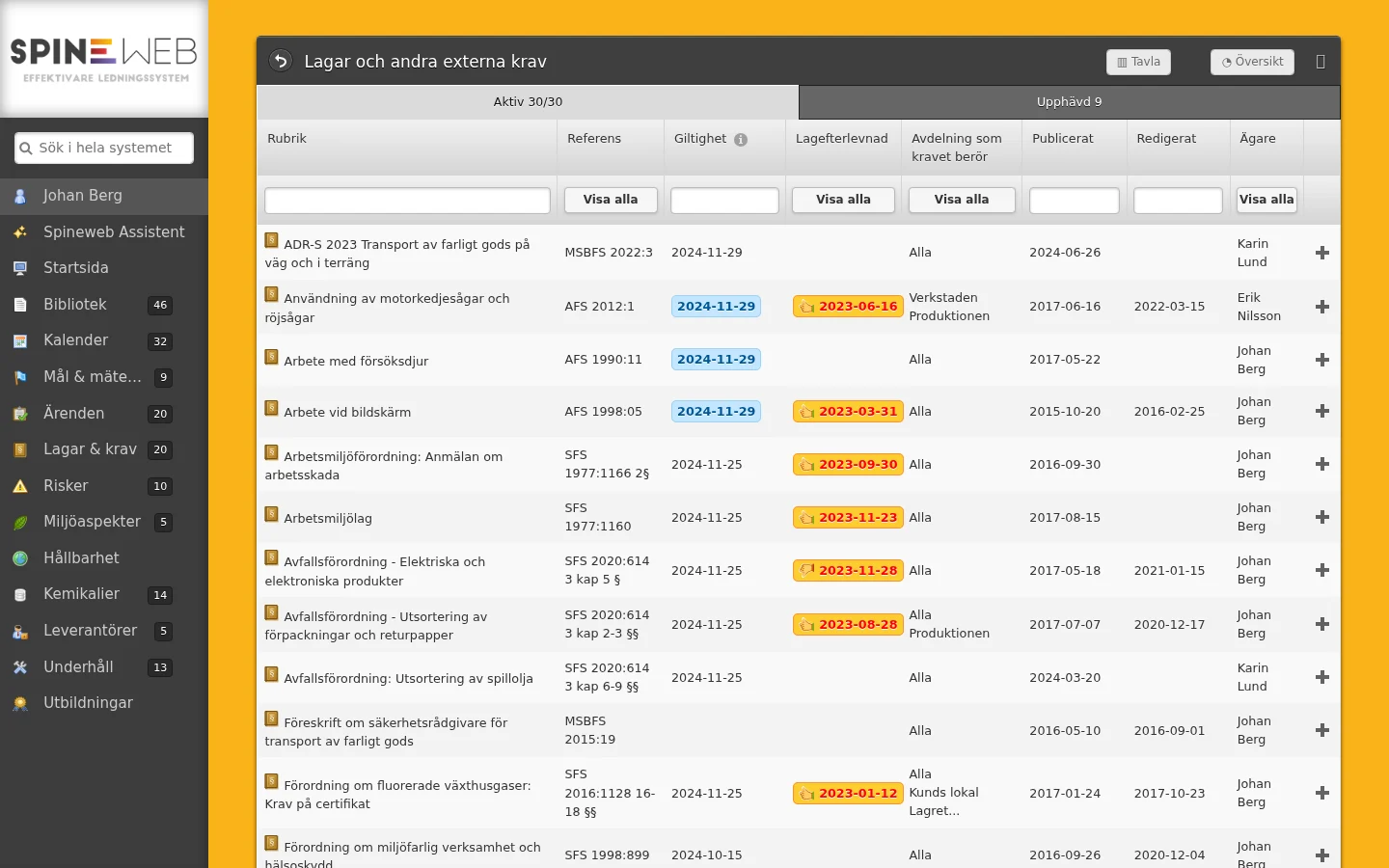
Legal compliance monitoring means systematically identifying and following up on laws, regulations, authority requirements and other binding obligations relevant to an organization's operations. It is not enough to know which laws apply — the organization must also continuously monitor changes and evaluate whether requirements are being met.
The consequences of missing a regulatory change can be serious: fines, enforcement actions, loss of permits, loss of certification or reputational damage. Especially in environmental legislation, chemical legislation and occupational health and safety legislation, changes occur continuously at a rapid pace.
ISO 14001 and ISO 45001 explicitly require organizations to identify applicable legal requirements, evaluate compliance regularly, and retain documented evidence of this. In practice, this means a structured legal monitoring system is necessary for all ISO-certified organizations.
A complete legal monitoring system includes: a register of relevant laws and regulations, linking requirements to responsible parties and business areas, evaluation intervals per requirement, documentation of how each requirement is met, notifications when regulations change, and exportable reports for auditors.
Stay updated on laws and regulations — without having to manually monitor hundreds of legal sources.
Build a structured register of laws, regulations, directives and authority requirements relevant to your operations, categorized by area.
Link each legal requirement to a responsible person or role. The responsible party is automatically notified when it is time for evaluation or when a requirement changes.
Set an evaluation interval per legal requirement — quarterly, semi-annually or annually. The system reminds automatically and the log shows the history of each evaluation.
Document how each legal requirement is met with references to routines, instructions and evidence. Automatically creates the audit documentation that certification bodies require.
Link legal requirements to affected documents, routines and cases. When a law changes, you immediately see which routines need updating and which cases are affected.
Export the legal register with compliance status, evaluation history and responsible parties — ready for auditors or supervisory authorities.
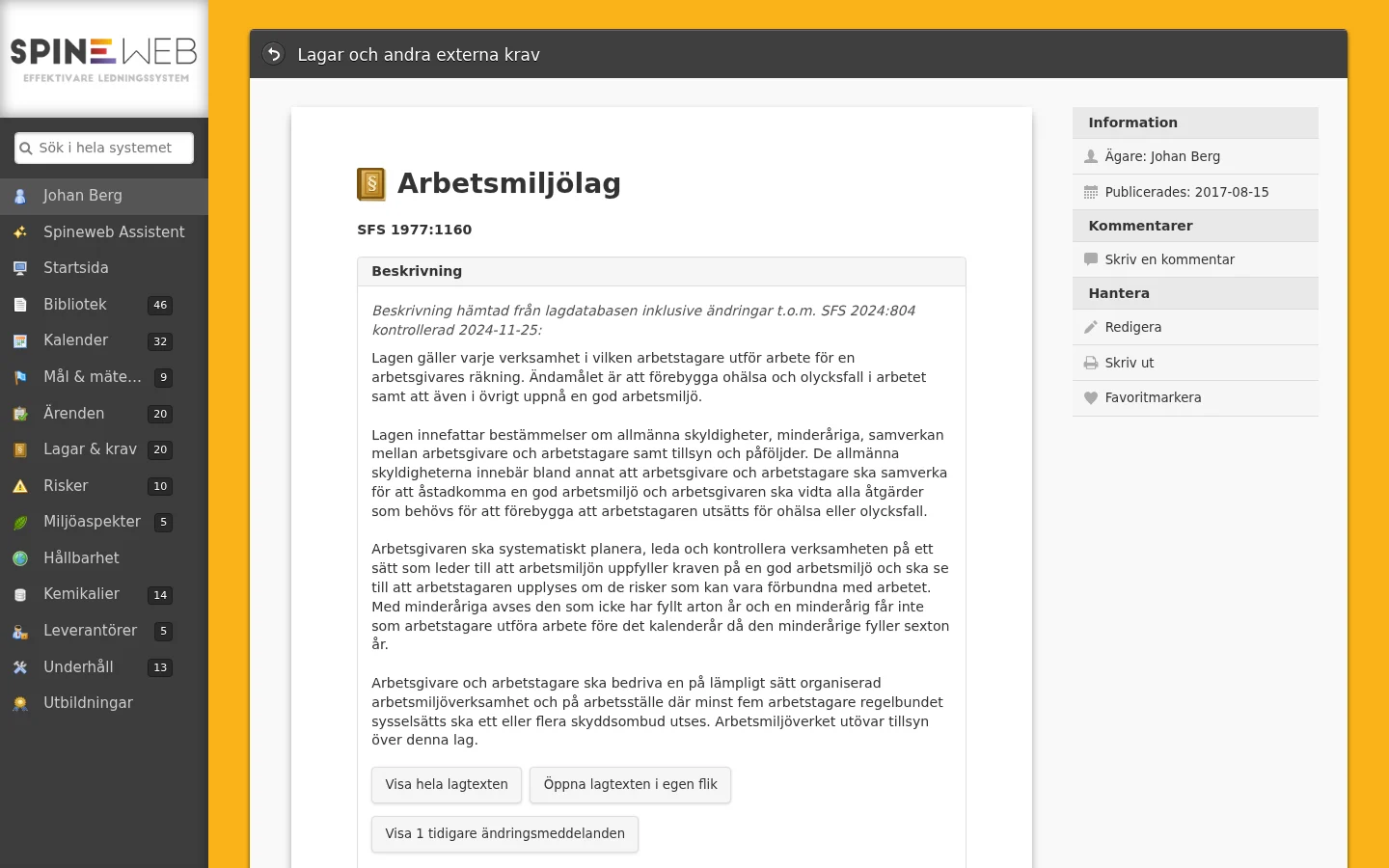
Legal monitoring in Spineweb is tightly integrated with other modules for maximum benefit.
The assistant can search your legal requirements, summarize evaluation status and run the built-in legislation update workflow.
AI processing runs on AWS Bedrock in eu-north-1 — your data never leaves the Nordics.
Legal compliance monitoring means systematic follow-up of laws, regulations and authority requirements relevant to your operations. Without a structured system, organizations risk missing regulatory changes, potentially leading to fines, enforcement actions, loss of certification or business risks.
It depends on your operations, but common areas include: the Swedish Environmental Code, the Work Environment Act, chemical legislation (REACH, CLP), product safety regulations, GDPR, and industry-specific requirements. Spineweb helps you identify and structure your relevant legal requirements.
The recommendation is continuous monitoring with formal evaluation at least once a year. In Spineweb, each legal requirement can be assigned an evaluation interval and the responsible party is automatically notified when it is time for review. New laws and changes can be registered immediately when published.
Legal monitoring specifically involves monitoring and evaluating legislation and regulatory requirements. Compliance management is a broader concept encompassing all types of requirements — laws, standards, customer requirements, internal policies — and the entire process of ensuring compliance. Spineweb's legal monitoring module is part of a broader system that also includes case management, document management and sustainability reporting.
In Spineweb, each legal requirement can be evaluated and documented with: date, responsible person, compliance status assessment, reference to routines and evidence, and any corrective actions. The documentation is directly exportable and can be shown to auditors, certification bodies and supervisory authorities.
Yes. Both ISO 14001 and ISO 45001 require the organization to identify applicable legal requirements, evaluate compliance regularly, and retain documented evidence. Without a structured legal monitoring system, it is practically impossible to meet these requirements in a verifiable way.
Book a demo and see how Spineweb helps you keep track of laws and regulations without manual work.